

.webp?width=300&name=Telephone%20Lines%20(1).webp)
Legacy analog telephone lines, commonly called POTS lines, are still used throughout multifamily and public housing properties for systems that rarely make a normal phone call: elevator emergency phones, fire alarm panels, access control and intercoms, security alarms, monitoring equipment, fax machines, meters and modems.
For years, those lines were easy to ignore. They worked, the bills got paid, and there was little reason to think about them.
That is changing quickly.
Copper Phone Service Is Becoming a Legacy Utility
POTS stands for “Plain Old Telephone Service,” the traditional analog dial tone historically delivered over a pair of copper wires. Copper is the physical infrastructure, while TDM is the older switching and transport technology behind many legacy telephone services.
Telephone carriers are now moving away from that infrastructure in three ways:
- Retiring it: removing or replacing copper facilities in specific areas.
- Grandfathering it: stopping new orders or expansion while temporarily continuing service for existing customers.
- Repricing it: increasing the cost of legacy services as newer alternatives become available.
Copper is being retired location by location, and the regulatory environment has increasingly made that transition easier for carriers.
In 2019, the FCC began removing protections around certain legacy copper services. Additional federal protections expired in 2022. Then, in March 2026, the FCC took further action making it easier for carriers to retire copper networks. Today, carriers are moving market by market while legacy line costs continue to rise.
For housing authorities, that turns an old telecom bill into a current budget and operational issue.
The Cost Can Hide in Plain Sight
One of the challenges with legacy telecom is that the expense is often spread across multiple carriers, accounts, departments and properties.
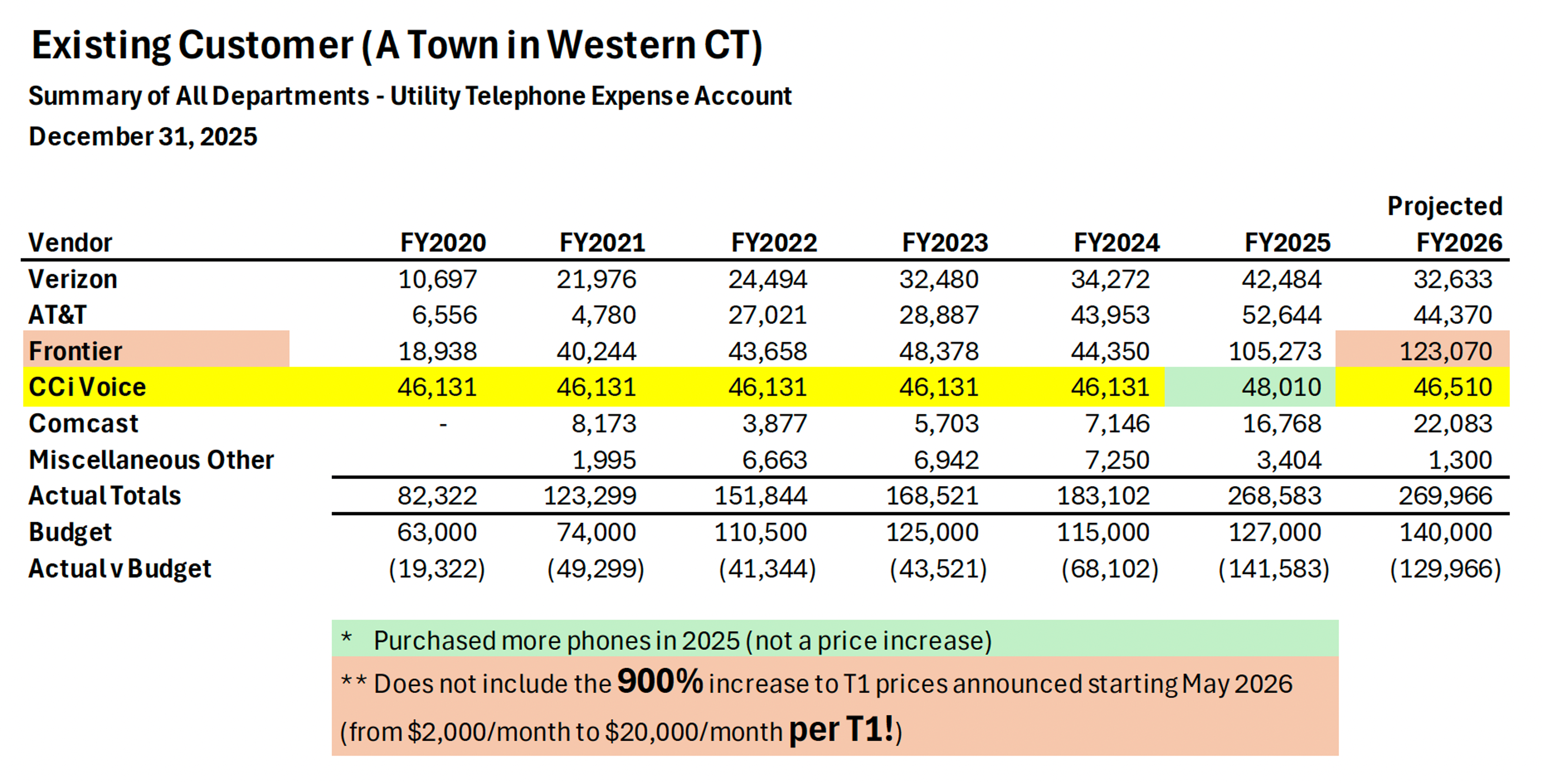
A customer in western Connecticut provides an example. Their total utility telephone expense grew from approximately $82,000 in FY2020 to more than $268,000 in FY2025. The carrier-announced an increase that would take certain T1 circuits from $2,000 per month to $20,000 per month.
Not every housing authority will see those exact increases, but the old assumption that legacy telephone costs will remain relatively stable no longer holds. A line that nobody has reviewed in five years may now be one of the fastest-growing expenses on the property.
The Bigger Risk Is What the Line Is Connected To
Cost is only half the problem.
In a housing authority, an analog line may be the communications path behind:
- Elevator emergency phones
- Fire alarm panels
- Access control and intercom systems
- Security alarms and monitoring
- Fax machines
- Building meters
- Older modem-based equipment
That makes this very different from simply replacing an old office telephone.
A high-rise property may have elevators, fire panels, entry systems, intercoms, cameras and monitoring equipment spread across multiple buildings and supported by multiple vendors. Responsibility may be divided among IT, maintenance, property management, elevator contractors, alarm companies and executive leadership.
And when something fails, the residents most affected may be elderly, disabled or mobility-limited.
Security starts with a reliable dial tone.
If the underlying communications path is unreliable, the system depending on it may be unreliable too.
Don't Start by Buying New Technology
The first step is not replacing every analog line. It's figuring out what you actually have.
A POTS audit gives a housing authority a clear inventory of its telecom environment before decisions are made.
1. Collect
Gather telecom bills, carrier portals, invoices, telephone numbers, account codes and a complete property/site list.
2. Map
Match every billed number to a physical building, room, device and responsible vendor.
3. Classify
Determine whether each line is supporting a life-safety system, security system, administrative function, duplicate service, or nothing at all.
4. Validate
Test the line and the equipment using it. For fire alarms, elevators and security systems, coordinate with the appropriate vendor rather than assuming that a dial tone means everything is functioning correctly.
5. Triage
Decide whether each line should be canceled or temporarily retained with a defined migration plan.
This is where housing authorities frequently find the opportunity: you can't manage a telecom expense you can't identify.
Modernization Can Be About More Than the Phone Bill
Once the audit is complete, the goal isn't simply to swap one line for another. It is an opportunity to look at communications and security infrastructure as one connected system.
Modern hosted phone service can reduce dependence on an on-site PBX, support staff working from multiple locations and provide built-in failover capabilities.
Modern video surveillance can add capabilities such as forensic search, crowd monitoring and automatic detection tools.
Access control can provide mobile credentials, temporary vendor access and alerts around events such as tailgating or attempts to use deactivated credentials.
The objective is to reduce operating costs while making the systems residents and staff depend on easier to manage.
Connecticut Housing Authorities Are Already Doing It
For the Danbury Housing Authority, CCi Voice completed a roughly $1 million security modernization project across six sites, including more than 225 cameras across 15 buildings, intercom systems in every apartment of two high-rise towers and access control in multiple buildings.
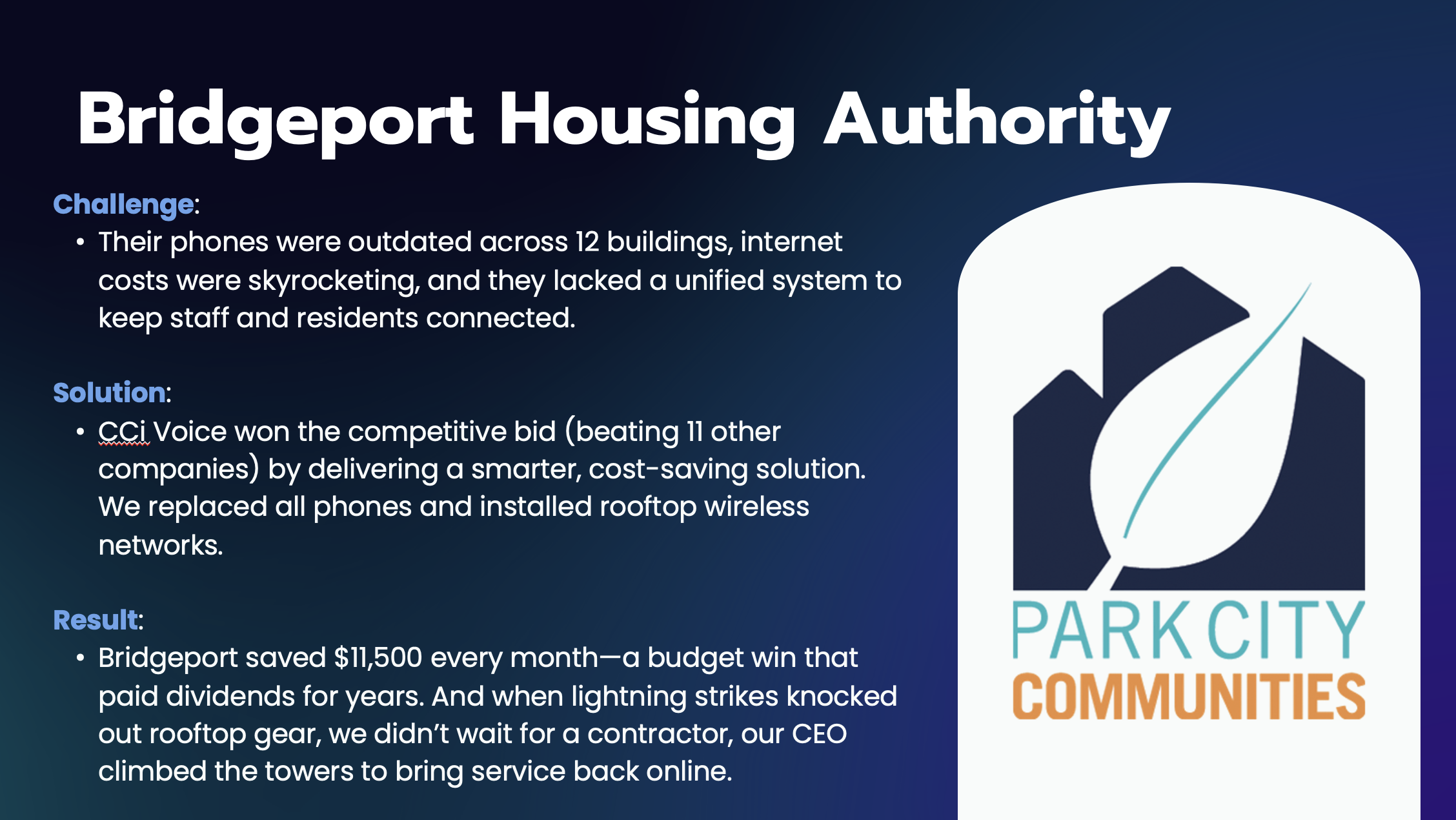
At the Bridgeport Housing Authority, an earlier communications modernization replaced outdated phones across 12 buildings and installed rooftop wireless networks. The project ultimately reduced costs by $11,500 per month.
Different properties will have different starting points. But the lesson is the same: old telecom costs do not have to remain fixed operating expenses forever.
What Housing Authorities Should Do Now
You don't need to know today what technology will eventually replace every legacy line.
You do need to know:
How many lines are you paying for?
What does each one actually do?
Which ones support life-safety or security systems?
Which ones can be eliminated?
And which ones need a migration plan before the carrier makes the decision for you?
Copper retirement is no longer something housing authorities should treat as a distant telecom issue. It is a budgeting, operations and resident-safety issue happening now.
Start With a POTS Audit
CCi Voice works with Connecticut housing authorities and municipalities to identify legacy telecom services, trace lines back to the equipment they support and determine where costs can be eliminated or infrastructure modernized.
If you're not sure what your housing authority is still paying for, send us a recent telecom bill. We'll help you start identifying the lines, costs and systems that deserve a closer look.